If you are budgeting for a 2026 launch, the honest answer to how much it costs to build an AI mobile app is: anywhere from around $25,000 for a focused MVP to $400,000+ for an enterprise platform. The range is wide because AI apps have more moving parts than a standard mobile app — model choices, data pipelines, and inference costs all swing the number. This guide breaks down the real cost drivers behind the cost to build an AI mobile app, gives concrete ballpark ranges, and shows you where to trim without gutting the product.
What actually drives the cost to build an AI mobile app
The total cost to build an AI mobile app is the sum of five variables. Get clear on these and you can estimate your own budget within a reasonable band.
- Feature scope — Auth, onboarding, payments, push notifications, and offline support each add real engineering hours before any AI is involved.
- AI complexity — Calling a hosted LLM through an API is cheap and fast. Fine-tuning a model, running computer vision, or shipping on-device AI is significantly more involved.
- Platforms — One platform (iOS or Android) costs less than both. Cross-platform frameworks like React Native and Flutter let you ship to both from a single codebase, cutting cost meaningfully.
- Integrations — Payment gateways, CRMs, analytics, and third-party APIs each carry integration and testing overhead.
- Data — Sourcing, cleaning, labeling, and storing data is often the most underestimated line item, especially for custom models or RAG (retrieval-augmented generation) systems.
The single biggest swing factor is AI complexity. A chatbot that wraps a hosted LLM might be 20% of your budget; a custom vision model trained on proprietary data could be 60%.
Ballpark cost ranges: MVP vs mid-tier vs enterprise
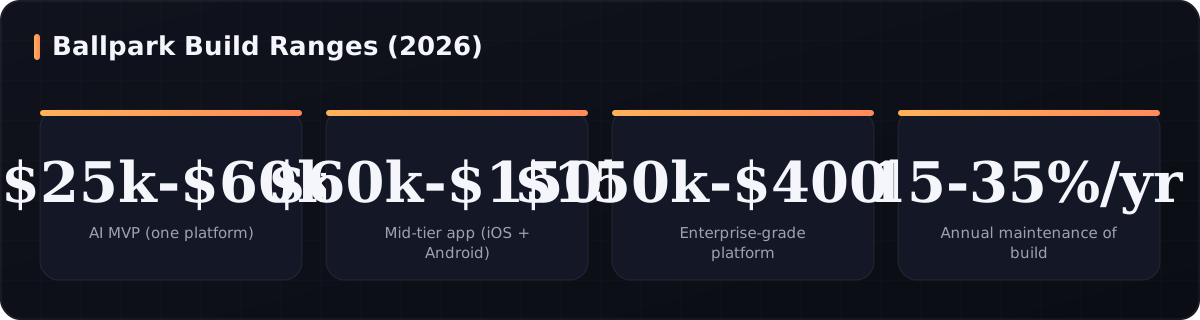 Typical 2026 build ranges. Ongoing LLM, infrastructure, and maintenance costs are separate.
Here is how the numbers typically shake out in 2026. These are full build costs — design, development, AI integration, QA, and launch — not ongoing fees.
| Tier | Scope | Typical AI work | Build range |
|---|---|---|---|
| AI MVP | One platform, core flows, hosted LLM | Prompt engineering, API integration | $25k–$60k |
| Mid-tier | iOS + Android, polished UX, integrations | RAG, light fine-tuning, vision APIs | $60k–$150k |
| Enterprise | Multi-platform, compliance, scale | Custom models, on-device AI, MLOps | $150k–$400k+ |
An AI MVP is the right starting point for most founders: it proves the concept with real users before you spend on custom models. A mid-tier build suits funded startups validating a market, while enterprise budgets apply when you need compliance (HIPAA, SOC 2), heavy scale, or proprietary models as a moat.
Hosted LLM vs custom model: the fork in the road
Your AI approach drives both build and running costs, so decide early.
Hosted LLM via API
Calling a model like Claude or another hosted LLM is the fastest, cheapest path to a working product. You pay per token, ship in weeks, and skip the infrastructure. The trade-off is recurring API costs that scale with usage and less control over the model.
Fine-tuned or custom models
Fine-tuning or training your own model gives you domain accuracy, lower per-request cost at high volume, and IP you own. But it demands quality data, ML engineering, and MLOps — pipelines for training, evaluation, and redeployment. Reserve this for when a hosted model genuinely can't meet your accuracy or cost needs.
On-device AI
Running smaller models directly on the phone removes per-request API fees, works offline, and keeps user data private. It raises build complexity and constrains model size, but for privacy-sensitive or high-frequency features it can pay for itself.
Rule of thumb: start with a hosted LLM, measure usage, then move to fine-tuned or on-device models only when the math or product requirements justify it.
Ongoing costs that drive up the cost to build an AI mobile app
The build is a one-time number. AI apps carry recurring costs that a static app does not, and these compound every month — so they belong in any honest estimate of the cost to build an AI mobile app over its lifetime.
- LLM API / inference — Token-based pricing for hosted models, or GPU/compute costs if you self-host. This is your most variable line and scales directly with active users.
- Infrastructure — Servers, databases, vector stores for RAG, storage, and bandwidth.
- Third-party services — Auth, analytics, push notifications, error monitoring, and payment processing fees.
- Maintenance — OS updates, bug fixes, security patches, and model retraining. Budget 15–35% of the build cost per year.
For a mid-tier app with moderate traffic, plan for a few thousand dollars a month in combined inference and infrastructure early on, rising with adoption. The key discipline is monitoring token usage from day one so costs never surprise you.
Build vs buy: when to use off-the-shelf
Not every AI capability needs to be built from scratch. The smart move is buying the commodity layers and building only what differentiates you.
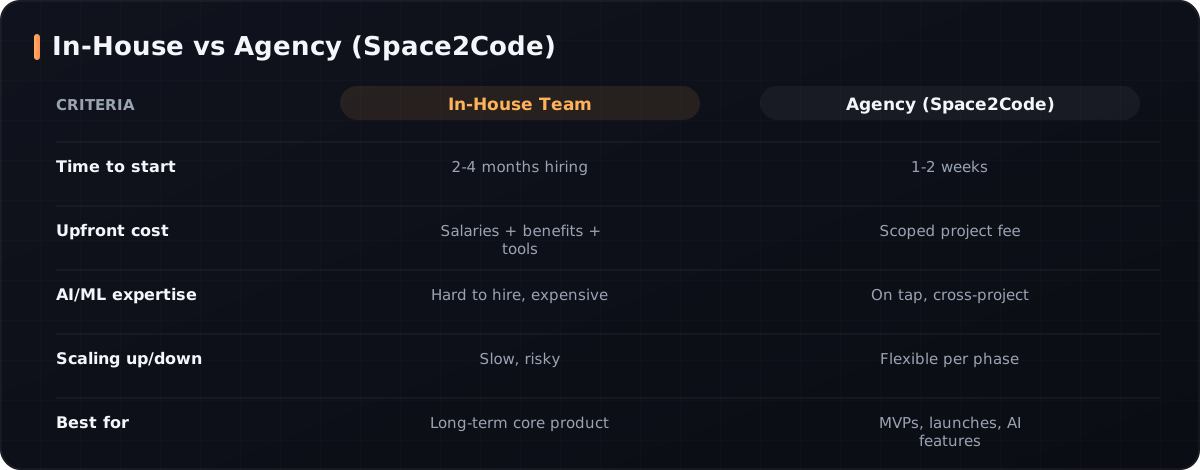 An in-house team versus partnering with an agency like Space2Code for an AI mobile build.
- Buy authentication, analytics, payment processing, and base model access — these are solved problems, and rebuilding them wastes budget.
- Build your core AI experience, proprietary data pipeline, and the UX that makes your product yours.
There's a second build-vs-buy question: hiring an in-house team versus partnering with an agency. Hiring senior AI and mobile engineers takes months and carries fixed salary, benefits, and tooling costs whether or not you're shipping. An agency like Space2Code lets you start in weeks, draw on cross-project AI/ML expertise, and scale the team to each phase. For MVPs, launches, and adding AI features to an existing app, the agency model is usually faster and cheaper; for a long-term core product, a hybrid (agency to launch, in-house to maintain) often works best.
A sample cost breakdown
To make this concrete, here's a representative breakdown for a mid-tier AI mobile app — cross-platform, with a RAG-powered assistant and a handful of integrations.
| Line item | Share of budget | Notes |
|---|---|---|
| UX/UI design | 12–18% | Research, flows, design system |
| Mobile development | 30–40% | React Native or Flutter, both platforms |
| Backend & APIs | 15–20% | Node.js/NestJS or Python/FastAPI |
| AI/ML integration | 15–25% | LLM, RAG, prompt engineering, eval |
| Data pipeline | 5–12% | Ingestion, cleaning, vector store |
| QA & testing | 8–12% | Manual + automated, AI output testing |
| Project management | 8–10% | Planning, coordination, delivery |
On a $100k build, that puts roughly $35k into mobile development and $20k into AI/ML — a realistic split that founders can sanity-check proposals against.
Practical ways to reduce cost
You can cut the cost to build an AI mobile app substantially without shipping a weaker product.
- Start with an MVP. Validate with one platform and a hosted LLM before investing in custom models.
- Go cross-platform. React Native or Flutter delivers iOS and Android from one codebase, saving up to 30–40% versus two native builds.
- Use hosted models first. Skip the cost of training until usage data proves you need a custom model.
- Cache and optimize prompts. Prompt caching and smaller models for simple tasks cut inference bills dramatically.
- Phase the roadmap. Ship a lean v1, learn from real usage, then fund the features users actually want.
- Partner strategically. A focused agency engagement avoids long hiring cycles and idle payroll.
Frequently Asked Questions
How much does it cost to build an AI mobile app in 2026?
A focused AI MVP on one platform typically runs $25k–$60k, a polished mid-tier cross-platform app $60k–$150k, and an enterprise-grade platform $150k–$400k+. Your exact figure depends on AI complexity, number of platforms, integrations, and data needs.
What are the ongoing costs after launch?
Plan for LLM API or inference costs (variable with usage), infrastructure and third-party services, and maintenance of roughly 15–35% of the build cost per year. Monitoring token usage from launch is the best way to keep these predictable.
Is it cheaper to use a hosted LLM or build a custom model?
For most apps, a hosted LLM is cheaper and faster to launch — you pay per token and skip the ML infrastructure. A custom or fine-tuned model only becomes cost-effective at high volume or when you need domain accuracy a hosted model can't provide.
Should I hire in-house or use an agency?
For MVPs, launches, and adding AI features, an agency like Space2Code is usually faster and more cost-effective than hiring. For a long-term core product, a hybrid approach — agency to launch, in-house to maintain — often delivers the best value.
Conclusion
The cost to build an AI mobile app in 2026 spans a wide range, but with the right scope, a hosted-LLM-first approach, and a cross-platform build, you can launch a credible AI product for a fraction of an enterprise budget — then scale spend as traction proves it out. The teams that win are the ones who start lean, measure usage, and invest in custom AI only where it creates real differentiation.
Want a precise estimate for your idea? The Space2Code team can scope your AI mobile app, recommend the right build-vs-buy mix, and give you a transparent budget. Contact Space2Code to get started.
Tags
Need Help with Mobile Development?
Our team of experts is ready to help you build your next project.
Get Free Consultation