The difference between an app users open once and one they open every day often comes down to intelligence built into the product itself. The right AI features that boost mobile app engagement turn passive screens into adaptive experiences that anticipate needs, surface the right content, and re-engage people before they drift away. In this guide, the Space2Code team breaks down ten high-impact AI features, what each one actually does, and the typical engagement and retention impact you can expect.
These numbers are illustrative ranges drawn from common industry patterns, not guarantees. Your results depend on your audience, data quality, and execution. Treat them as direction, not promises.
Why AI Engagement Features Matter Now
User expectations have shifted. People compare your app not to your direct competitors but to the most personalized, frictionless experiences they use daily. Static apps that treat every user identically feel dated and forgettable.
AI changes the economics of engagement. Instead of hand-tuning rules for every segment, machine learning systems learn from behavior and adapt continuously. The result is higher session frequency, longer retention curves, and better monetization without proportionally more manual work. The AI features that boost mobile app engagement below are the ones that consistently move the needle.
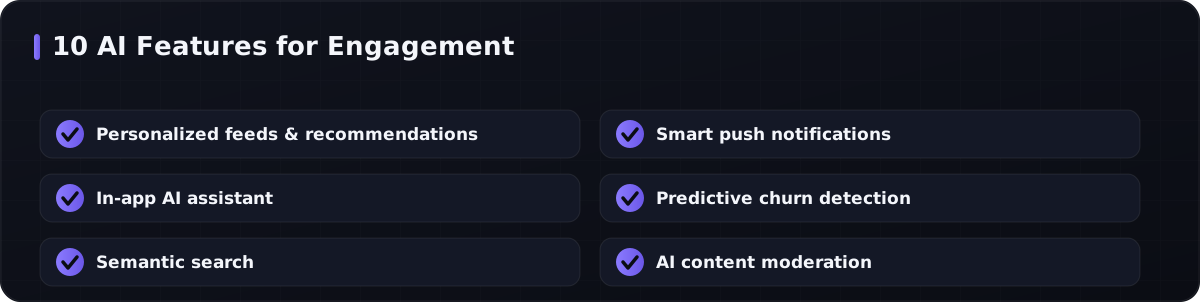 The ten AI features covered in this guide, from personalized feeds to smart paywalls.
1. Personalized Feeds & Recommendations
What it does: A recommendation engine ranks content, products, or actions based on each user's history, similar users, and real-time context. Instead of a generic chronological feed, every user sees what is most relevant to them.
Impact: Personalization is the single highest-leverage AI feature for most apps. Teams commonly see a 20-40% lift in session frequency and meaningfully longer time-in-app. It is the backbone of engagement for social, commerce, media, and learning apps.
Start simple with collaborative filtering or content-based ranking, then layer in deep learning models as your data grows.
2. Smart Push Notifications
What it does: AI decides who to notify, what to say, and crucially when to send. Models predict each user's optimal send time and the message most likely to bring them back, while suppressing notifications that would annoy or fatigue them.
Impact: Naive batch-and-blast push gets ignored and drives uninstalls. AI-timed, personalized notifications routinely deliver 2-3x higher open rates and reactivate dormant users without increasing opt-outs.
The win here is as much about restraint as reach. Sending fewer, better-targeted notifications often outperforms sending more.
3. In-App AI Assistant
What it does: A conversational assistant powered by an LLM helps users find features, answer questions, complete tasks, and get unstuck without leaving the app or contacting support. It can be grounded in your own knowledge base using retrieval-augmented generation.
Impact: A well-built assistant reduces support load, shortens time-to-value, and increases the share of users who reach key activation milestones. Apps with strong assistants see higher feature adoption and fewer abandoned sessions.
This is an area where Space2Code frequently helps clients ship production-grade chatbots that stay accurate and on-brand rather than hallucinating.
4. Predictive Churn Detection
What it does: A model scores each user's likelihood of churning based on behavioral signals like declining sessions, skipped features, or support friction. High-risk users are flagged so you can intervene with offers, nudges, or human outreach before they leave.
Impact: Catching churn early is far cheaper than winning users back. Targeted interventions on at-risk cohorts commonly cut early churn by 10-25%, directly improving lifetime value.
The key is acting on the prediction. A churn score is only useful if it triggers a thoughtful, well-timed response.
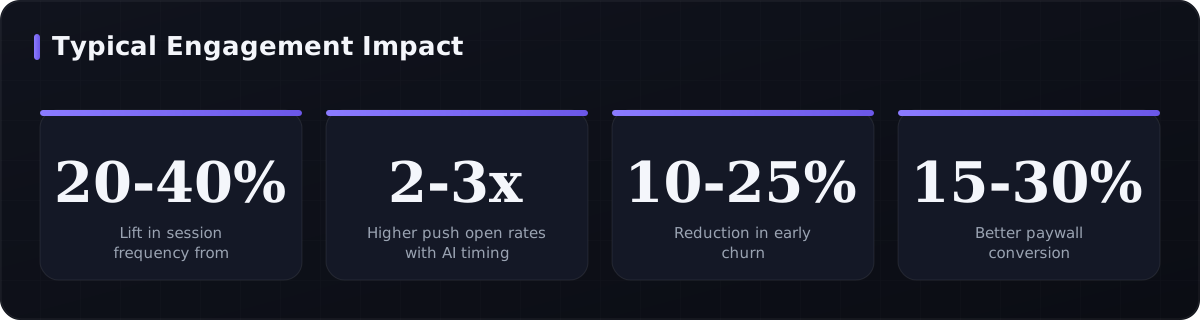 Typical impact ranges teams report; treat these as directional, not guaranteed outcomes.
5. Semantic Search
What it does: Traditional keyword search fails when users do not know the exact terms. Semantic search uses embeddings to understand intent and meaning, returning relevant results even for vague, misspelled, or natural-language queries.
Impact: Better search means users find what they want faster, which lifts conversion and satisfaction. Apps that upgrade to semantic search see more successful searches and fewer dead-end sessions that end in users leaving.
6. AI Content Moderation
What it does: For any app with user-generated content, AI moderation automatically detects spam, abuse, harassment, and policy violations in text, images, and video, in real time and at scale.
Impact: A safe, high-quality community keeps good users and drives away bad actors. Strong moderation protects retention, reduces legal and brand risk, and is effectively non-negotiable for social and marketplace apps as they grow.
7. Voice Interfaces
What it does: Speech-to-text and natural language understanding let users interact hands-free, search by voice, dictate content, or issue commands. Modern on-device models make this fast and private.
Impact: Voice lowers friction in contexts where typing is awkward, such as driving, cooking, or accessibility use cases. It expands your addressable audience and can become a sticky differentiator in the right vertical.
8. AR & Computer Vision
What it does: Computer vision lets your app see and understand the real world, powering features like try-before-you-buy AR, visual search, document scanning, and object recognition.
Impact: Vision features create memorable, shareable moments that drive organic growth. In commerce, AR try-on reduces returns and boosts purchase confidence; visual search shortens the path from inspiration to action.
9. Dynamic Onboarding
What it does: Instead of one fixed tutorial, AI adapts the onboarding flow to each user's goals, source, and early behavior, emphasizing the features most likely to make this user successful.
Impact: Onboarding is where most apps lose users. Personalized, adaptive onboarding improves activation rates and is one of the most reliable levers for reducing early churn and lifting day-7 and day-30 retention.
10. Smart Paywalls
What it does: AI optimizes when to show the paywall, which offer to present, and how to price or bundle it for each user, based on engagement signals and willingness-to-pay patterns.
Impact: Dynamic, well-timed paywalls commonly deliver a 15-30% improvement in conversion versus a one-size-fits-all wall, while reducing the resentment that hurts retention when monetization feels aggressive.
Comparing the Features
Not every feature fits every app. Use this table to prioritize based on effort and where the impact lands.
| Feature | Primary metric moved | Relative effort | Best for |
|---|---|---|---|
| Personalized feeds | Session frequency | Medium | Content, commerce, social |
| Smart push | Reactivation, open rate | Low-Medium | Almost any app |
| In-app AI assistant | Activation, support load | Medium-High | Complex or SaaS apps |
| Predictive churn | Retention | Medium | Subscription apps |
| Semantic search | Conversion, findability | Medium | Catalog-heavy apps |
| Content moderation | Community health | Medium | UGC and marketplaces |
| Voice | Accessibility, friction | Medium | Hands-free contexts |
| AR & vision | Organic growth, confidence | High | Commerce, utility |
| Dynamic onboarding | Activation, D7 retention | Low-Medium | Every app |
| Smart paywalls | Revenue per user | Medium | Freemium apps |
A practical sequence for most teams: start with dynamic onboarding and smart push for quick wins, add personalization and churn prediction as your data matures, then invest in heavier features like AR or an AI assistant where they fit your product.
How to Roll These Out Without Overbuilding
The mistake we see most often is treating AI as one giant project. Instead:
- Pick one metric you most need to move, like day-7 retention or paywall conversion.
- Ship the simplest version of the matching feature and measure it against a holdout group.
- Iterate on real data rather than chasing model sophistication for its own sake.
- Layer features gradually, so each addition compounds engagement rather than competing for attention.
This keeps risk low and ensures every AI investment pays for itself. Space2Code builds these features as focused, measurable releases rather than speculative overhauls.
Frequently Asked Questions
Which AI feature should I build first?
Start with whatever maps to your weakest funnel metric. For most apps, dynamic onboarding and smart push notifications offer the fastest return because they are relatively low effort and directly attack early drop-off. Personalization comes next once you have behavioral data to learn from.
Do I need a huge amount of data to use these features?
Less than people assume. Push timing, onboarding, and content moderation can start working with modest data using pretrained models and simple heuristics. Recommendation and churn models improve with scale, but you can launch a basic version early and refine it as usage grows.
Are the engagement numbers in this article guaranteed?
No. The percentages are illustrative ranges based on common industry patterns. Actual results depend on your audience, data quality, baseline metrics, and execution. Always validate with A/B tests against a control group before claiming impact.
Can these AI features run on-device for privacy?
Many can. Voice recognition, vision tasks, and some personalization and ranking models now run efficiently on-device, which improves latency and protects user privacy. Space2Code specializes in on-device AI for mobile and can advise on what belongs on the device versus the cloud.
Conclusion
The apps that win retention are not the ones with the most features but the ones that feel like they understand each user. Adopting even three or four of these AI features that boost mobile app engagement can meaningfully lift session frequency, retention, and revenue, especially when you ship them as focused, measurable releases rather than all at once.
If you are planning an AI-powered mobile app or want to add intelligent engagement features to an existing one, Contact Space2Code. Our team designs, builds, and ships production AI for mobile, and we would love to help you turn one-time installs into loyal daily users.
Tags
Need Help with AI & Machine Learning?
Our team of experts is ready to help you build your next project.
Get Free Consultation